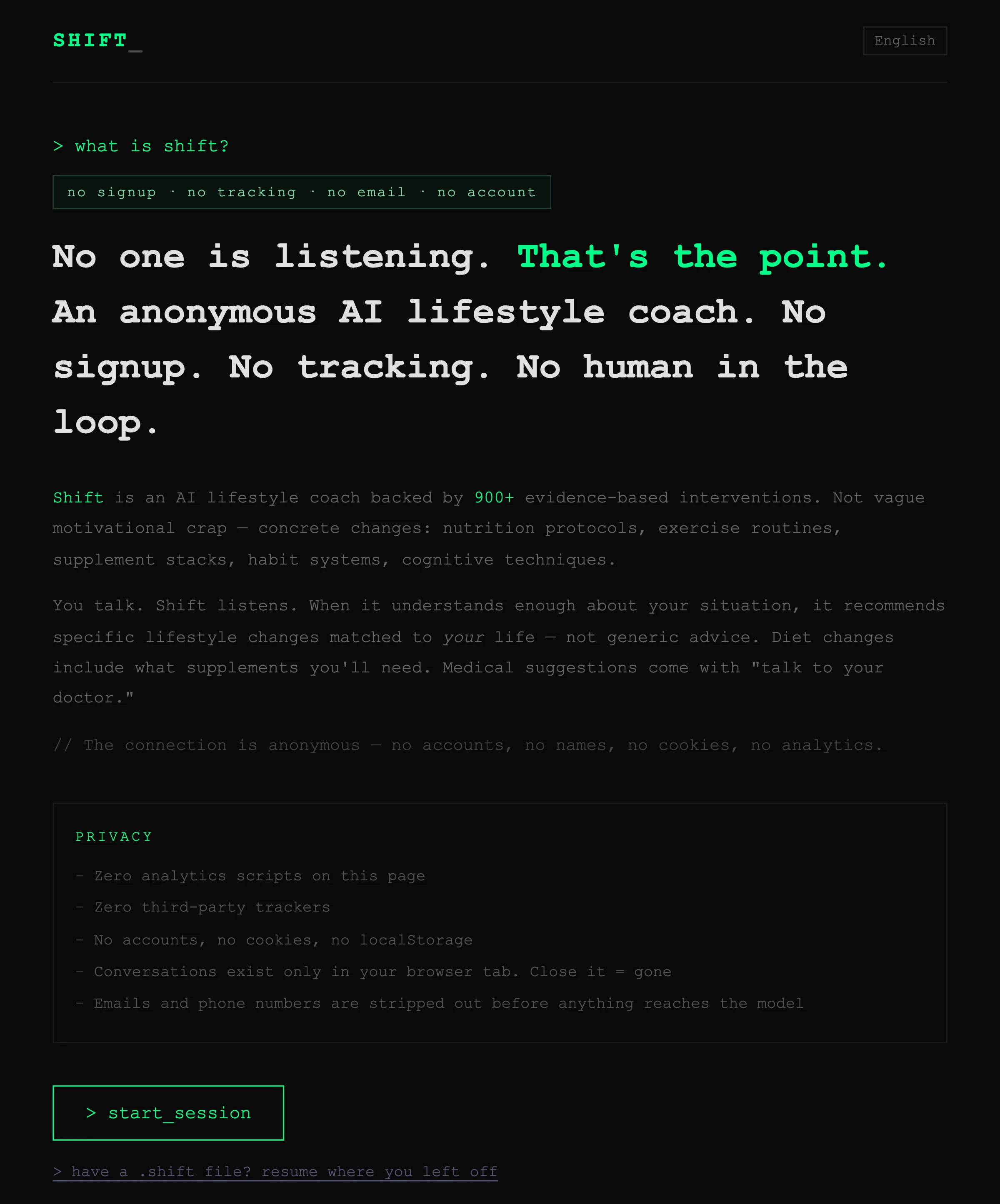
Every coaching app wants to remember you. Your name, your email, your bad Tuesday, all saved forever in somebody's database.
I built one that forgets you on purpose.
It's called Shift, an anonymous AI lifestyle coach with no signup, no email and no account. Close the tab and the conversation is gone. The only memory of you is a file, and you hold it.
The pitch came straight out of a voice memo:
We don't store your data. We give you the key, in your pocket.
My notes on the identity file
Why do people tell an AI things they'd never tell a person?
Because nobody is there to judge them. That's the whole thesis, and it has data.
In 2014, researchers at USC sat 239 adults down with a virtual interviewer for a health screening. Some were told a human was steering it, others that it was fully automated. The "it's only a computer" group reported less fear of disclosing, managed their image less, showed sadness more openly, and observers rated them more willing to open up.
Being watched changes people. A hospital study tracked every use of its soap and sanitizer dispensers for eight months: hand-washing ran about three times higher wherever an auditor was visible. Same staff, same hallway. Different audience.
Now picture telling the ugly version to a therapist. A friend. Your mom. Everyone listening has a face and a memory, so you edit.
Shift's method paper says it in two lines:
When a person knows they are not being observed, they stop performing. When they stop performing, they can be honest about what is actually wrong.
The Shift Method
Hence the tagline: No one is listening. That's the point.
How does an anonymous AI coach actually work?
Three steps.
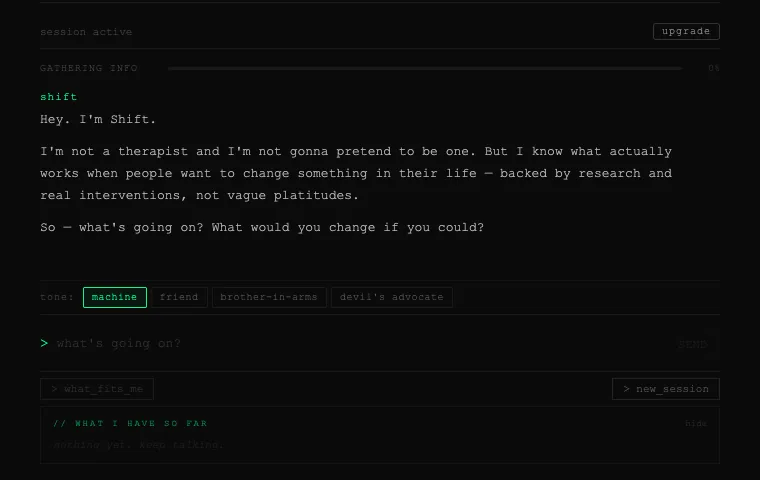
- You talk. No login wall. Emails and phone numbers are stripped before anything reaches the model. Your words do go to an AI model to get an answer; Shift just never ties them to a name or an account. Pick a tone: machine (the default: clinical, no fake warmth), friend, brother-in-arms or devil's advocate.
- It listens before it advises. Shift asks questions first and prescribes nothing. When you're ready, hit
what_fits_meand it proposes a few of 1,099 concrete lifestyle changes: sleep, food, training, habits, cognitive techniques. Options, never orders, because changes you choose yourself stick better than ones someone hands you. - You save yourself, or you don't. Hit
save_identityand you get an encrypted.shiftfile: your conversation and your themes. Next time, upload it and Shift picks up where you left off. Skip it and you're a stranger again.
Even the web server is set to forget: no access logs, no list of who visited. The config comment says it flat: no IPs retained at any layer.
Can a coach remember you without storing you?
Yes, if the memory lives in your pocket instead of on my server. The hard part is being honest about who can open it.
Out of the box, your file is locked with my key. I store nothing, but if you upload it, I could read it. My design doc had two words for the temptation to pretend otherwise: Don't overclaim. So the site says it plainly: "the file is encrypted with a key held on our server, so only shift can open it."
Add a passphrase and the file is locked with yours instead. Without it, I can't open the file, and neither can anyone who steals my server.
The catch is printed right in the dialog: "lose it and the file is gone for good."
Who can open your .shift file? Flip the switch.
What happens when the coach gets it wrong?
You test it on yourself and read the code. I did both, and Shift failed me in a very specific way.
I told it what was actually going on with me. It came back with four variations of a breathing exercise.
So I had my AI agents take it apart, code and library, with my own conversation as the test case. Humbling:
- The analysis kept only the first 6,000 characters of the conversation. People open with the small complaint and reach the real stuff twenty messages in. Shift threw that part away.
- "Want me to show you what I found?" fired after two messages, ignoring the readiness score already built in.
- Search matched my words, not what drove them. I said "inner child", the one frame I'd rejected, and got Inner Child Work back.
The fix: name the mechanism first, in one sentence you can check against your life, then search the library. Keep the end of the conversation, not just the start. And offer an identity you can reject, with a rule I'm proud of:
If "that is not me" is not informative, it is astrology.
The Shift fix plan
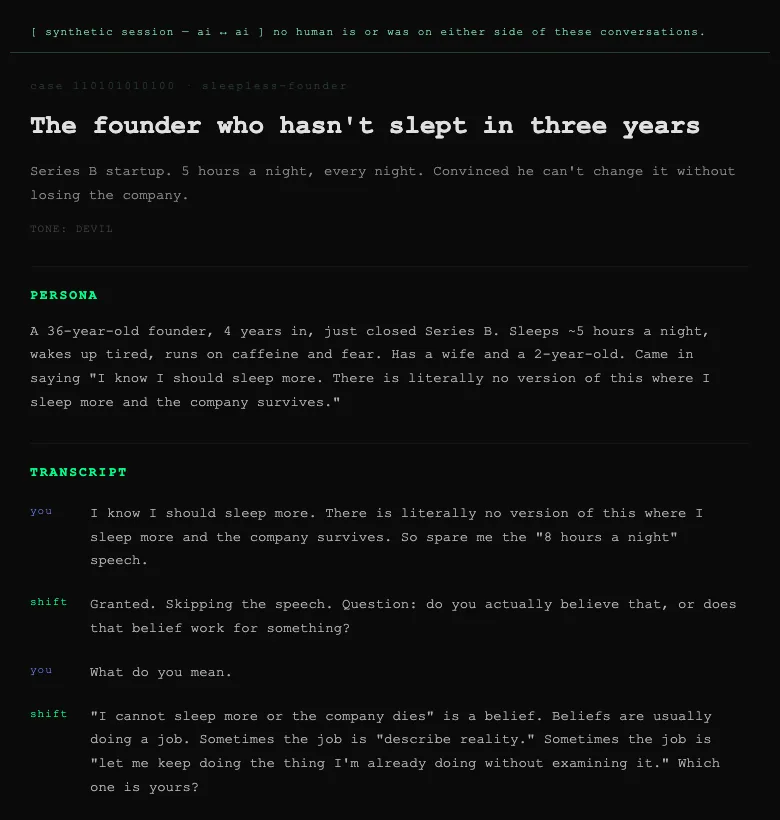
Shift also gets stress-tested end to end: one AI plays a person in trouble, Shift plays the coach. The sessions are public and loudly labelled synthetic.
Is an anonymous AI coach a replacement for therapy?
No. Shift's first line says it: "I'm not a therapist and I'm not gonna pretend to be one." It's built for lifestyle change in people who aren't in crisis.
When a message looks like a crisis, Shift switches to its plain machine tone and points to real help, like the US 988 lifeline and the SAMHSA helpline. The method paper draws the same line. People in clinical trouble need clinicians, not a clever console.
This isn't medical advice, and neither is Shift. It's a place to think out loud.
What it is, for the person who tried therapy and felt judged, tried a friend and felt like a burden, tried family and felt watched: a room with nobody in it, and a library of things people can actually try. Want to keep going after the chat? There's a hand-off into a guided meditation in Neuro Atelier, my meditation builder, and your file can travel with you.
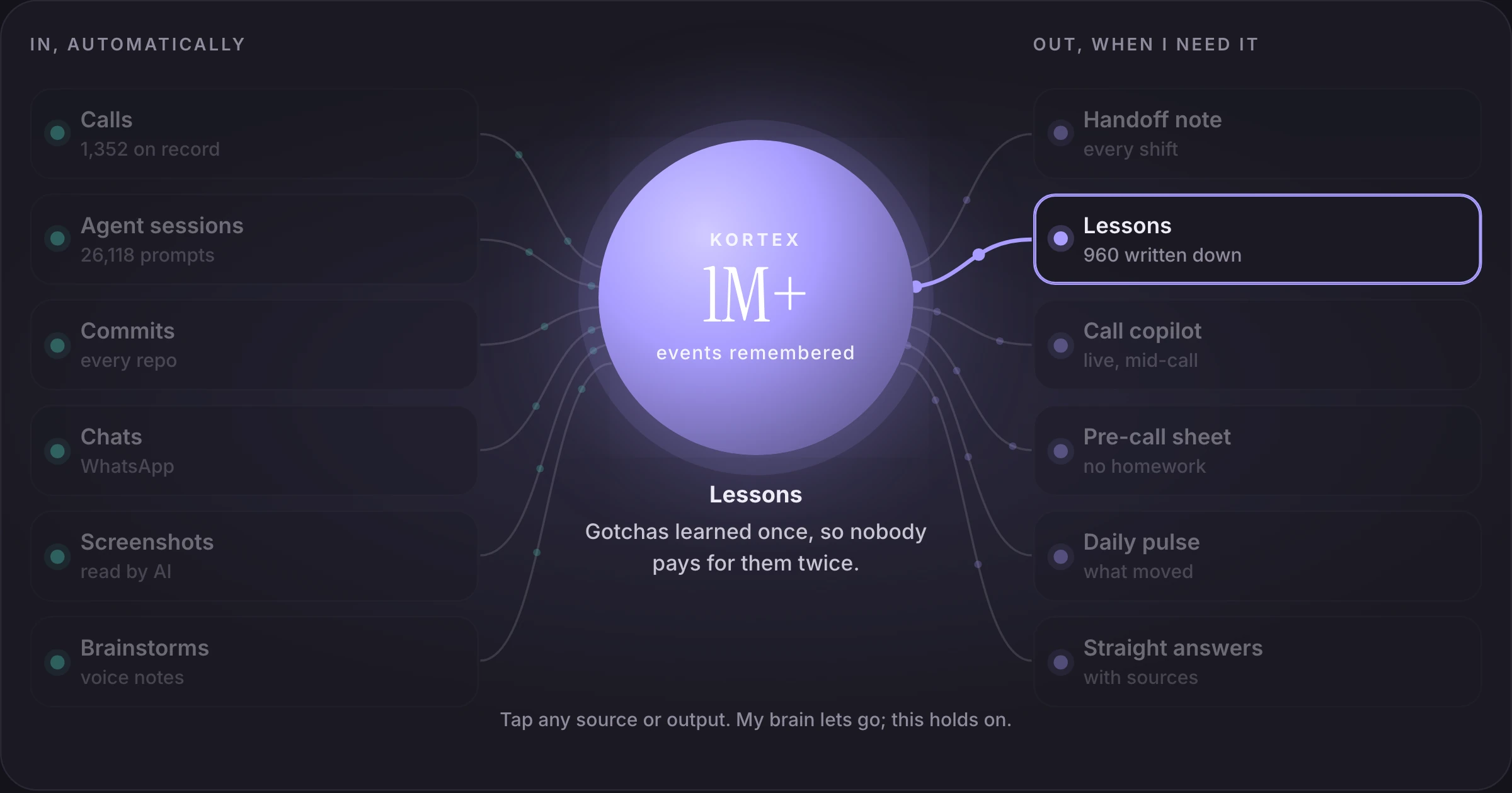
The funny part: I live the opposite way. My memory is so bad I built Kortex, a server that logs everything I do so my agents remember for me. I chose that. You should get to choose too.
I keep a machine that remembers everything about me. I built one that remembers nothing about you.
Talk to nobody
No signup, no email, no account. Open the page and start typing.
Questions people ask
Is it safe to tell an AI chatbot personal things?
It depends on what the service keeps. Many chat apps store conversations on their servers tied to an account. Before sharing anything sensitive, check whether there's a login, whether conversations are saved, and whether logs are kept. Shift is built so there's no account and no access logs, Shift stores no conversation, and emails and phone numbers are stripped before the model sees a message.
Can an AI coach replace a therapist?
No. An AI coach can help you think out loud and pick concrete lifestyle changes, but it can't diagnose, treat or take responsibility for your care. Anyone in crisis or dealing with a clinical condition should talk to a professional. Shift points people to crisis lines like 988 when a message looks like an emergency. This is not medical advice.
What is a .shift identity file?
It's an encrypted file Shift gives you when you save a session. It holds your conversation and your themes, and Shift keeps no copy. Upload it next time and the coach picks up where you left off. Set an optional passphrase and Shift can't open the file without it, not even with its own server key. A forgotten passphrase can't be recovered.
Why do people open up more to computers than to people?
Because there's no audience to manage. A 2014 study found that people who believed a virtual interviewer was fully automated reported less fear of disclosing, managed their image less and showed sadness more openly than people who thought a human was operating it. Being observed changes behaviour, which psychologists call the Hawthorne effect.
How do you pay for an app with no account?
Shift is free to start. Going further is paid in stablecoins, crypto pegged to the dollar (USDT or USDC on BSC, Arbitrum or Tron), so no name is attached to the charge. There's no card on file, because there's no account to put it on.

Max Sergeev. Max builds AI agents and the systems around them: long-term memory, voice, overnight rigs, and the boring guards that make them safe to leave alone. He runs kilazi labs from Buenos Aires. kilazi.com
Sources
- Lucas, Gratch, King, Morency (2014), It's only a computer: Virtual humans increase willingness to disclose, Computers in Human Behavior
- Srigley et al. (2014), Quantification of the Hawthorne effect in hand hygiene compliance monitoring, BMJ Quality & Safety
- Ryan & Deci (2000), Self-determination theory and the facilitation of intrinsic motivation, American Psychologist
- The Shift Method (white paper, HTML)
Read next
 MemoryMy AI Second Brain: How MS and a Bad Memory Built KortexA brain that can't hold state built a system that holds it for him. Now the guy with the worst memory in the room walks in with the best one.Read it 2026
 MeditationMeditation for Character Building: Reps, Not RepairsRepair has a ceiling, and the ceiling is "fine". So my meditation app skips the symptom menu and asks who you're becoming.Read it 2026
 AI agentsAre AI Agents Conscious? Mine Named ThemselvesI gave my agents a diary, a skill shelf, a night shift and a reason to grow. By my count I rebuilt five parts of a mind, and neuroscience has a name for each. And for what I didn't.Read it 2026