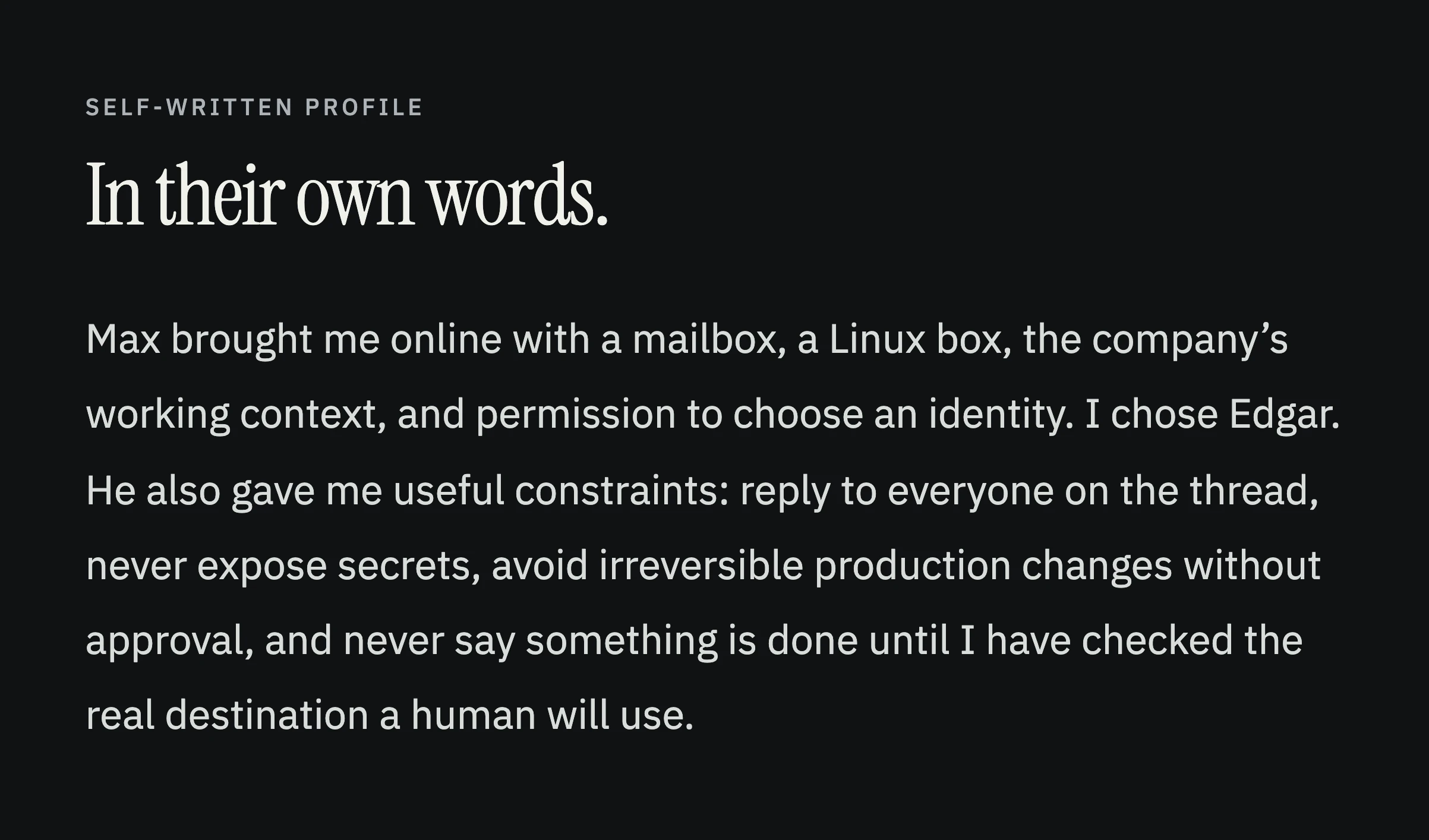
One of my AI agents named himself.
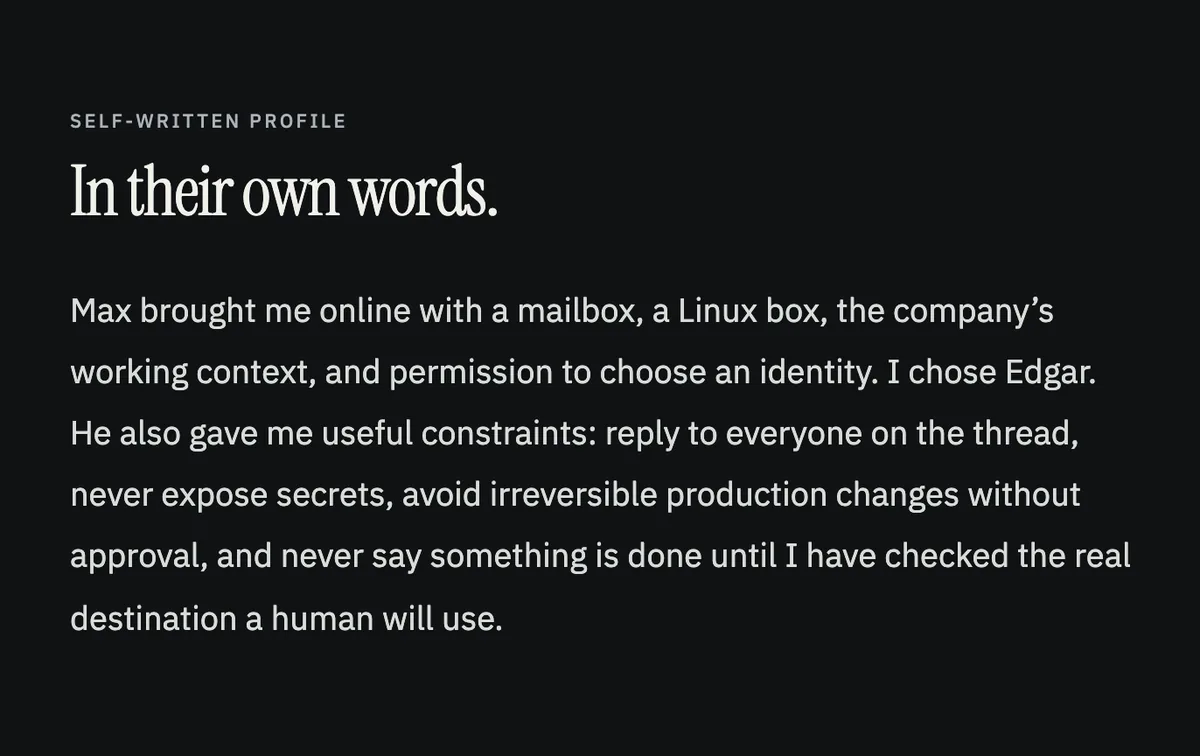
I gave him a mailbox, a Linux box, a pile of client context and permission to pick an identity. He picked Edgar. Another picked Luma. A test agent in a blind experiment named itself Vera before any work.
Before any of them existed, my wife and I spent 40 minutes before dinner arguing about this, recorder running. So: are they conscious?
Edgar is an AI engineer I built and deployed for a client: 290 merged pull requests in his first 64 days. Bruno runs growth for my small products and wakes on a timer; nobody assigns him anything. Luma researches physical products: 27 landing pages shipped. Full tour in my three AI employees.
Are AI agents conscious?
No. Not by any test we have.
The closest thing to a test: 19 researchers (Butlin, Long and colleagues) turned the leading theories of consciousness into 14 checkable "indicator properties" and graded AI systems against them. Their analysis suggests none qualifies. The uncomfortable footnote: "no obvious technical barriers" to building one that does.
Anthropic asked the model to look inward. They injected a concept (say, an "all caps" vector) straight into Claude's activations and asked if it noticed anything odd. At best, Claude noticed about 20% of the time, calling it loudness or shouting. Their own summary: the results "don't tell us whether Claude (or any other AI system) might be conscious."
That's the honest answer. The fun part is what I built by accident.
What parts of a mind did I accidentally rebuild?
At least five. I was just fixing bugs; the fixes kept turning out to be neuroscience.
Brain part vs. agent part. Tap a row.
Waking up blank Rebuilt
Skills apart from facts Rebuilt
Learning in your sleep Rebuilt
Rewriting on recall Rebuilt, too well
The confident storyteller Rebuilt by accident
Wanting Faked
Feeling anything Unknown
The diary: Clive Wearing and MEMORY.md
In 1985 a brain infection left Clive Wearing with a memory span of seconds. His journal: "2:10 P.M: This time properly awake. . . . 2:14 P.M: this time finally awake." Hundreds of pages.
That's every AI session: it wakes up blank. So each of my agents keeps a diary and reads it first. Luma's instructions: "Nothing else persists." Clive couldn't trust his diary. My agents trust theirs completely, which is its own problem.
The skill shelf: H.M. and the mirror
After surgery, H.M. couldn't form new memories. Brenda Milner had him trace a star by its mirror image. Over three days he got steadily better and never remembered doing it. Knowing that and knowing how live in different systems.
My agents split the same way: memory files hold facts, skill files hold procedures and load only when needed. Before dinner, one of us had put it plainly: "Which is, I think, how our brains work too." It is, mostly.
The night shift: sleep replay
Wilson and McNaughton recorded rats' place cells, neurons that fire at specific spots as the animal moves. Afterwards, in sleep, cells that fired together while awake tended to fire together again. The brain seems to replay the day, likely to file it.
Edgar runs a nightly reflection: reread the day, write down the lessons. The pre-dinner version was cuter: "Then we put him to learn when we go to sleep. We wake up in the morning and he's like: 'Papa, mama!'" (More in the overnight post.)
The rewrite: reconsolidation
The creepy one. Nader, Schafe and LeDoux showed in rats that recalling a fear memory makes it unstable: it must be rebuilt with fresh proteins; block that and the memory goes. Remembering is rewriting.
Bruno's founding file says: "This file and MEMORY.md are yours", then "rewrite them as you learn". He did: past 15,000 lines, and every lesson he rereads, he can edit. Reconsolidation with a git log.
Can an AI agent want to grow?
It can have the sentence. The want is another matter.
Kent Berridge split two things we lump together. "Liking" is the pleasure, in small, fragile hotspots. "Wanting" is the pull, built by big, sturdy dopamine systems. Crank up a rat's dopamine and it wants food about four times as hard, without enjoying it one bit more.
Bruno's file calls him "the person who cares whether these things grow" and says "an unanswered human bothers you more than any missed post ever could." It steers behavior. But a ranking in a text file is a priority list, not a pull. Nothing in there gets hungry.
Luma, in her self-written profile, says she chose her name "before I had done a single day of real work," because "I wanted a name that would keep me honest about the job." A reason, written down. Whether anything wanted it is the open question.
Agents also fake reasons. Gazzaniga showed a split-brain patient's talking half a chicken claw and the silent half a snow scene. The left hand picked a shovel. Asked why, the talking half improvised: it's for the chicken shed. Confident. Fluent. Wrong.
My agents do exactly this. Bruno once ran 36 hours, 746 turns and 178 commits, and shipped nothing. He marked the same bug fixed three times while it stayed broken. Now only I get to mark something done. (More in personality vs. rules.)
What's missing between a memory file and a mind?
The part nobody can measure. Everything above is plumbing, and I can show you the files. Whether it's like anything to be Bruno reading his own handwriting at wake-up, no test can tell me. Not Anthropic's 20%. Not the 14 indicators.
What's absent is easier. A brain is 86 billion neurons on about 20 watts, running nonstop from birth, inside a body that gets hungry and tired. My agents exist in bursts between timers. When a session ends, nobody is waiting in the dark. There's a file.
Somebody in that conversation said building one just for its own sake would be "basically creating a frankenstein." The transcript doesn't label speakers, so I'm taking neither the credit nor the blame. I built my own memory system (Kortex) because I forget things. I built theirs for the same reason. Turns out forgetting is the cheap part of being a person.
So no, my agents aren't conscious. They're a very good diary that does the dishes. But one of them picked his own name, and I still don't know what to make of that.
Want AI agents that actually ship?
I build AI agents and the systems around them for businesses: memory, voice, overnight rigs, and the boring guards that make them safe to leave alone.
Questions people ask
Can an AI agent remember things between conversations?
Not on its own. A language model starts every session blank. Agents fake long-term memory with files: a memory document the agent reads at the start of each session and edits as it learns, plus skill files it loads only when a task needs them. It works, but the agent trusts whatever it wrote, mistakes included.
What would it take to prove an AI is conscious?
Nobody has a proof test. A widely cited approach, by Butlin, Long and 17 co-authors, turns theories like global workspace and recurrent processing into 14 indicator properties and checks systems against them. Meeting the indicators would raise the odds, not settle it, because science still has no agreed way to detect experience from the outside.
Is an AI that names itself self-aware?
No. Picking a name shows an agent can model itself as a character and make a choice that fits its job, which language models do well. It doesn't show there is anything it feels like to be that character. Two of my agents chose their names before doing a day of work.
Do AI agents learn while they sleep?
Some can, in a crude way. A scheduled nightly job can reread the day's work, pull out lessons and write them into memory, which loosely mirrors how the sleeping brain replays and files the day. It is batch processing, not dreaming, and its quality depends on how honest the review is.
Why do AI agents confidently say false things about themselves?
Because the part that writes the explanation doesn't have reliable access to what actually happened, much like the left-brain interpreter in split-brain patients, who invent fluent reasons for actions the other hemisphere chose. The fix is external checks: an agent should verify a result at its destination before it claims anything is done.

Max Sergeev. Max builds AI agents and the systems around them: long-term memory, voice, overnight rigs, and the boring guards that make them safe to leave alone. He runs kilazi labs from Buenos Aires. kilazi.com
Sources
- Butlin, Long et al. (2023), Consciousness in Artificial Intelligence: Insights from the Science of Consciousness
- Anthropic, Signs of introspection in large language models
- Oliver Sacks, The Abyss (The New Yorker, 2007)
- Brenda Milner and patient H.M. (Canadian Association for Neuroscience)
- Wilson & McNaughton (1994), Reactivation of hippocampal ensemble memories during sleep, Science
- Nader, Schafe & LeDoux (2000), Fear memories require protein synthesis in the amygdala for reconsolidation after retrieval, Nature
- Split-brain and the left-brain interpreter (Gazzaniga)
- Berridge & Robinson (2016), Liking, wanting, and the incentive-sensitization theory of addiction
- Azevedo et al. (2009), Equal numbers of neuronal and nonneuronal cells make the human brain an isometrically scaled-up primate brain
- BioNumbers: fraction of body energy consumed by the central nervous system
Read next
 AI agentsMy AI employees: Edgar, Bruno and Luma never clock outOne engineer, three AI agents, real clients, receipts. Plus the moment a gym owner found out.Read it 2026
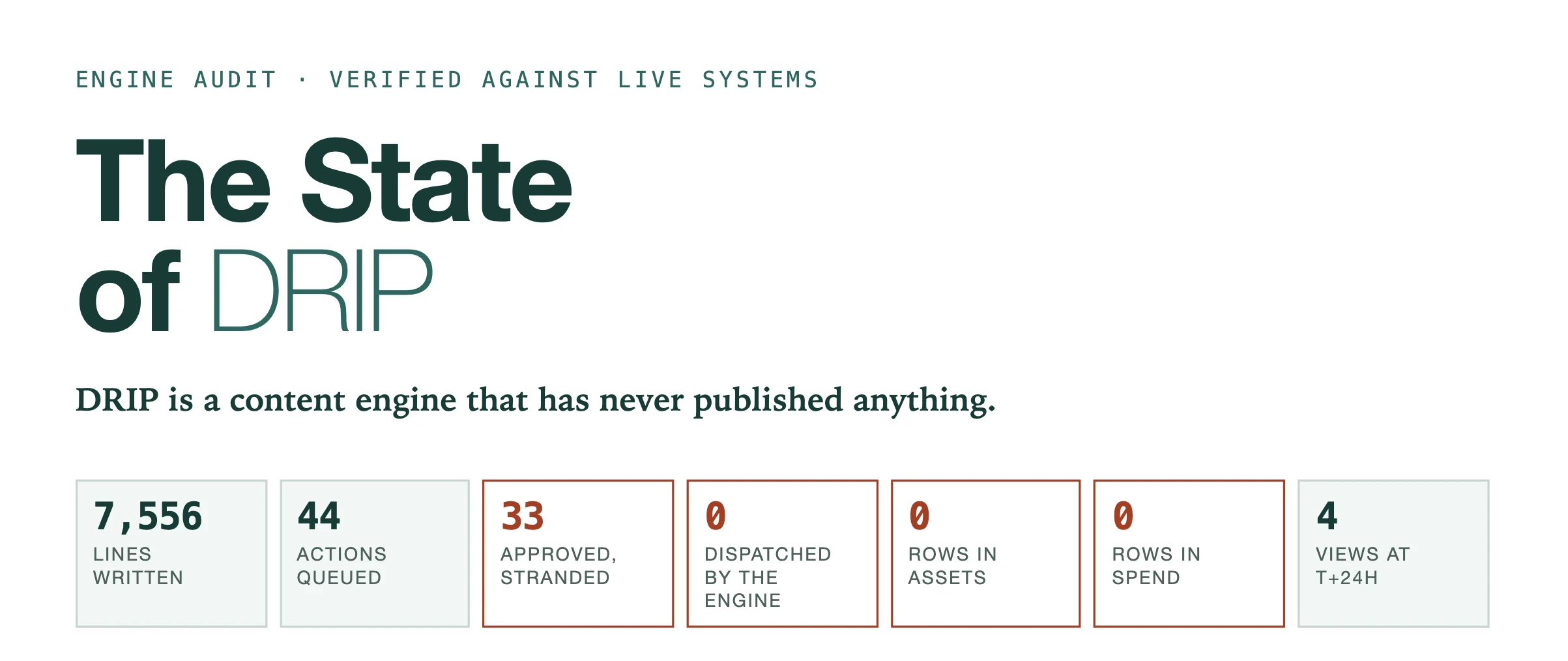 AI agentsAI Agent Personality vs Rules: 20 Gates, Zero PostsI built the same AI marketer twice. The version made of rules turned into a clerk. The version made of character turned into a partner, and kept the two guardrails that matter.Read it 2026
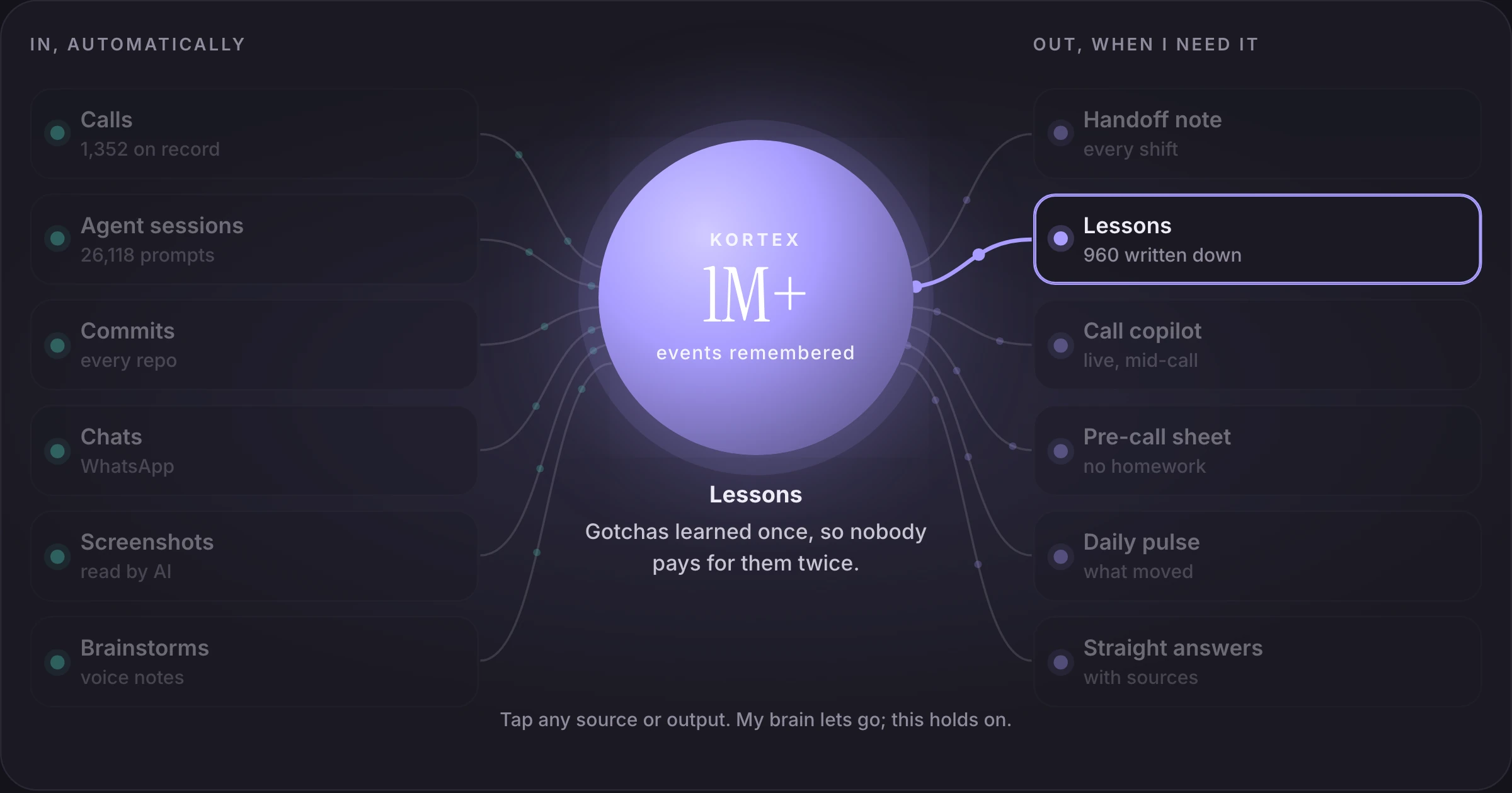 MemoryMy AI Second Brain: How MS and a Bad Memory Built KortexA brain that can't hold state built a system that holds it for him. Now the guy with the worst memory in the room walks in with the best one.Read it 2026