"Hey Siri, Sugar Log insulin."
"How many units?"
"Three."
"Logged 3 units."
That's the whole ritual. Wrist up, two sentences, wrist down. I'm on insulin, and that exchange is the reason I log at all.
Stanford Medicine once wrote that life with type 1 diabetes takes about 180 health-related decisions a day. Every one of them starts with a number you had to write down.
Why do most diabetes logging apps fail?
Because they're built for everyone, so they fit nobody. Open app, find the screen, pick the type, type the number, save. Ten taps, often with a fork in the other hand.
So you skip it. And a log with holes is a log that lies.
An app built for everyone
- Unlock, open, find the right screen
- Type the number with one thumb
- Guess the carbs, alone
- Forget the long-acting dose, find out later
Vitals, built for me
- "Hey Siri, Sugar Log insulin" from the wrist
- Siri asks one question, I answer
- Say what I ate, or snap a photo
- It nags me every 30 minutes until I've logged it
I don't need an app that does everything. I need one that does my day: bilingual, boxing, allergic to forms.
How does "Hey Siri, Sugar Log" actually work?
It uses Apple's App Shortcuts: phrases the app ships with, which Siri knows the moment it's installed. No setup.
The catch: a phrase can only carry a value from a fixed list. So "Sugar Log sugar 140" in one breath is impossible, and Siri has to ask "What was the reading?" instead. The code looks fine at first, then breaks when the app is actually built.
So anything with a closed vocabulary goes in the phrase. "Sugar Log large meal" logs a meal with an estimated carb load, zero questions. "Sugar Log boxing" logs a workout. "Sugar Log I ate" asks what, then takes free speech: "some carrots and nuts" lands verbatim.
The name took three tries. First Glucolog. Then Anota, Spanish for "write it down", which my English-only Siri heard as "add note" and handed to Notes. Then Vitals, which on the watch collides with Apple's own Vitals app. So on screen it's Vitals, and out loud it's "Sugar Log".
Once, Siri ignored the app and ran a web search instead. The culprit: I had deleted the Shortcuts app, which hosts App Shortcuts in the first place. Comedy.
Built in a day: what the prototype actually was
By midnight on day one, my first real reading had gone from my mouth to a chart, through phone, watch and a small server. The next day's 17 commits added the dashboard, the forecast, the reminders and the carb estimates.
My AI agents wrote the code, the same crew that runs on Kortex, my AI memory. My own body did QA.
Later the same app grew a breathing coach for my watch. But first, it broke in honest ways. A 293 I logged by voice never reached the dashboard: iOS suspends a Siri action the instant it answers, killing the upload mid-flight. The fix brought back the 293, plus a second reading nobody knew was missing.
The photo estimator guessed a biscuit weighed 18 grams, then reported all 18 grams as carbs. Now the model only guesses the weight; the server works out the carbs.
And I refused to pay Apple's $99 developer fee, so the app expires every seven days. That's why the server holds the real copy of every entry.
- Night oneEmpty folder to a voice-logged reading on phone, watch and dashboard
- Day two, middayForecast, insulin and carbs on board, 30-minute long-acting nag
- Day two, afternoonCarb estimates from a sentence or a photo, per-food absorption speed
- LaterA breathing coach on the watch, inside the same app
- NextA real CGM feed
How does the glucose prediction work?
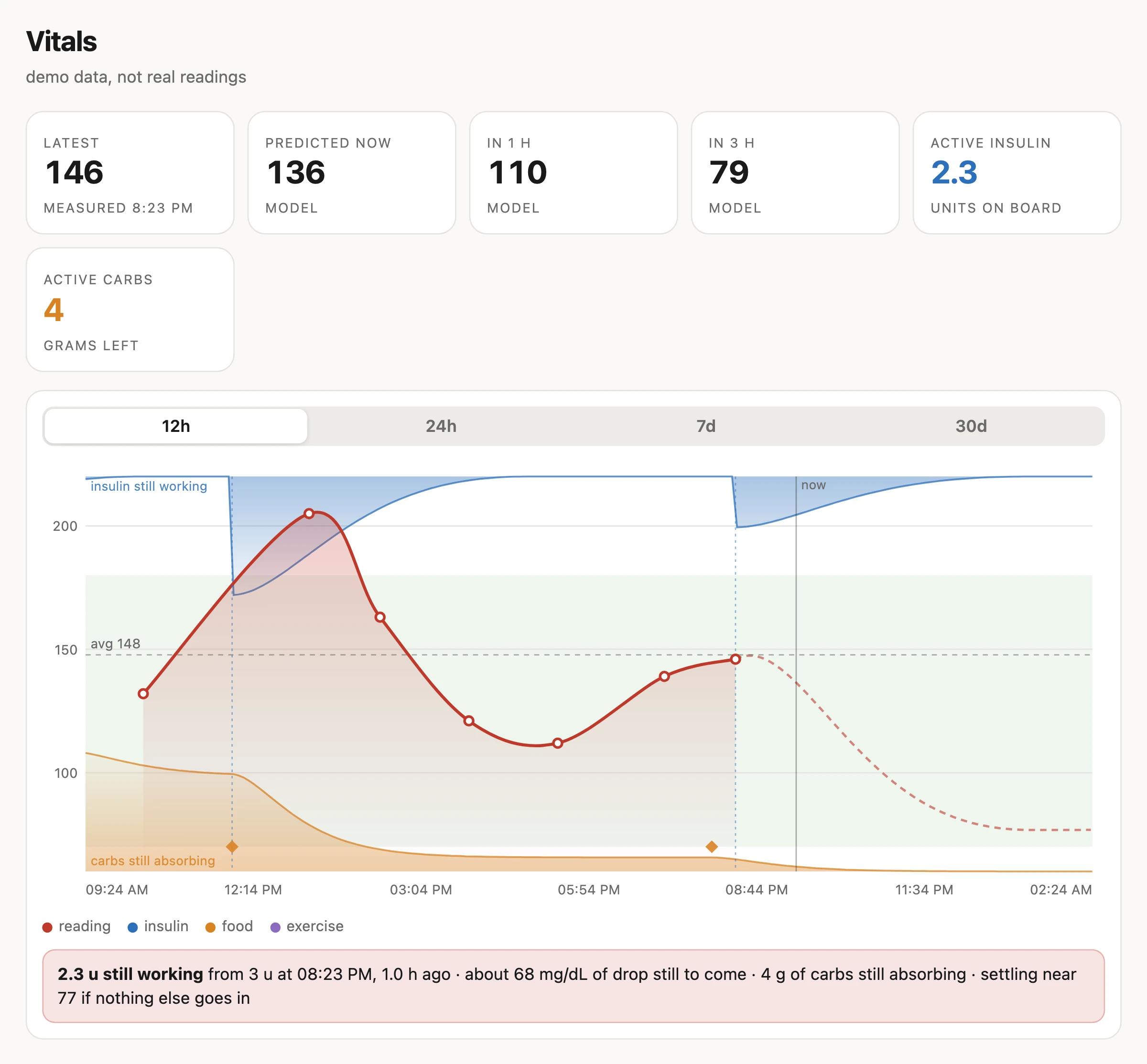
It starts from my last reading, subtracts what my insulin will still do, and adds what my food will still do. Two curves, no magic.
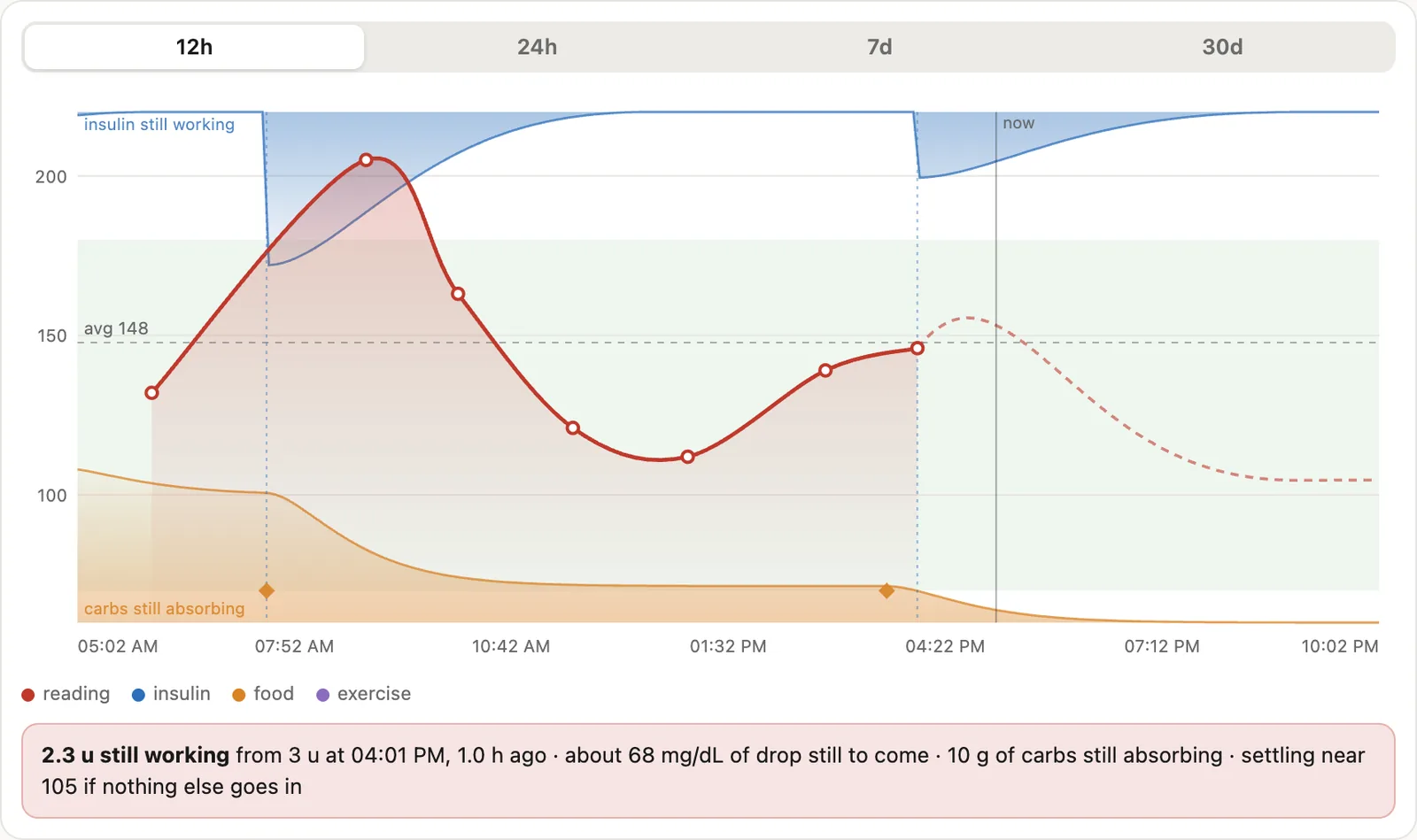
The insulin curve is the exponential model open-source apps that dose insulin automatically, like Loop and AndroidAPS, use, set to peak at 75 minutes and finish by five hours. The food curve is Hovorka's two-compartment gut model, a standard model of digestion, with the peak set by glycaemic index: orange juice hits in half an hour, lentils take their time.
Fat and protein add a slow tail, which is why pizza comes back hours later and no carb count sees it coming.
Play with a toy version of the same maths:
Toy model: starts at 150, sensitivity 45 and carb ratio 13 (rule-of-thumb defaults). Shaded band is 70-180. Not your numbers, not advice.
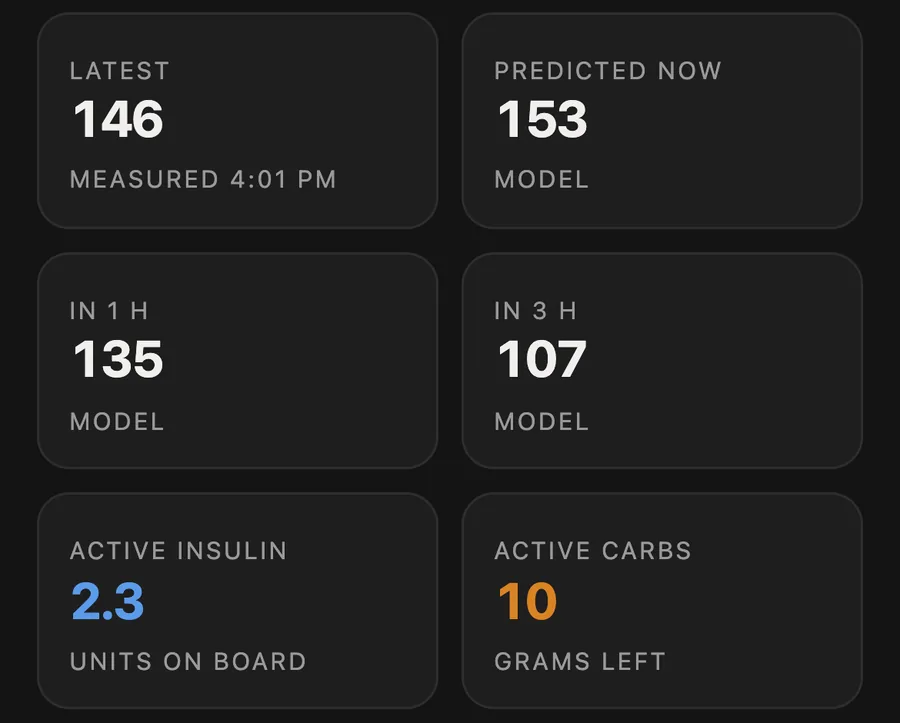
The phone shows six cards: latest reading, predicted now, in one hour and in three, insulin still working, carbs still arriving. Below 55 it just says "<55", because a predicted 40 and a predicted minus 60 mean the same thing: go check.
Is the forecast accurate?
Not very, and I measured it: a back-test on 66 fingerstick readings over almost five days, a median 65 minutes apart. Errors are in mg/dL, the US unit for blood sugar.
So the three-hour number is the shakiest thing on the screen. I tried a trend correction, the trick those auto-dosing apps use: nudge the forecast by how far reality has drifted from it. It made the error worse (average error went from 65.0 to 67.2 mg/dL) and got reverted: fingersticks an hour apart don't carry a trend.
The model also can't see my mornings. My own complaint, word for word: "he thinks my sugar will go to shit because i put a lot. i, on the other hand, dont think so, because its morning and i usually have a peak..." ("He" is the model.)
So the forecast never tells me what to do. If it expects a fall of 60 points within an hour, or a dip under 80 within two, it sends one nudge: check your sugar. A reason to measure, never a reason to act.
What's next: connecting a CGM
I wear a FreeStyle Libre 2, a continuous glucose monitor that estimates glucose every few minutes from a tiny sensor under the skin. That's the data the forecast has been starving for.
The plan: the Vitals server reads the same feed Abbott's LibreLinkUp follower app gets, through an unofficial API. Pairing over Bluetooth would steal the sensor from the official app and its alarms, and I'm not trading a real alarm for a prettier chart. Planned, not built.
Then the trend correction gets a fair retrial, with readings every few minutes instead of every hour.
The best health app I've ever used has one user. It answers to "Sugar Log".
Want AI agents that actually ship?
I build AI agents and the systems around them for businesses: memory, voice, overnight rigs, and the boring guards that make them safe to leave alone.
Questions people ask
Can Siri log insulin or blood sugar?
Yes, but not in one sentence. A third-party app can ship App Shortcuts so Siri recognises a phrase like "Sugar Log insulin", then asks a follow-up such as "How many units?". A phrase can only carry values from a fixed list, so a free number has to come as the answer to that question.
Why log diabetes data by voice instead of typing?
Because logging is friction, and friction creates gaps. Voice works when your hands are busy, your phone is in your pocket or you're mid-meal. A complete log matters more than a pretty one: any forecast or pattern is only as good as the entries behind it.
What is insulin on board?
Insulin on board is the part of a rapid-acting dose that is still working in your body. Apps estimate it with an activity curve: a typical model peaks around 75 minutes and fades out over about five to six hours. It helps explain why glucose keeps falling after a dose seems "done".
Do I need a CGM to predict blood sugar?
Not strictly, but it helps a lot. With fingersticks an hour apart there's no reliable trend to follow, so forecasts drift. A continuous glucose monitor estimates glucose every few minutes, which is the kind of data trend-correcting models are built for. Either way, use a prediction as a reason to measure, not to dose.
Is Kilazi Vitals available to download?
No. It's a personal tool I built for my own routine and run on my own devices. This post explains how it works so you can steal the ideas, not install the app. It isn't a medical device and nothing here is medical advice.

Max Sergeev. Max builds AI agents and the systems around them: long-term memory, voice, overnight rigs, and the boring guards that make them safe to leave alone. He runs kilazi labs from Buenos Aires. kilazi.com
Sources
- Apple Developer Documentation: App Shortcuts
- NIDDK: Continuous Glucose Monitoring
- Stanford Medicine: New research shows how to keep diabetics safer during sleep
- Gillis et al., Glucose estimation and prediction through meal responses (Hovorka gut model), J Diabetes Sci Technol
- Abbott FreeStyle Libre: LibreLinkUp app
Read next
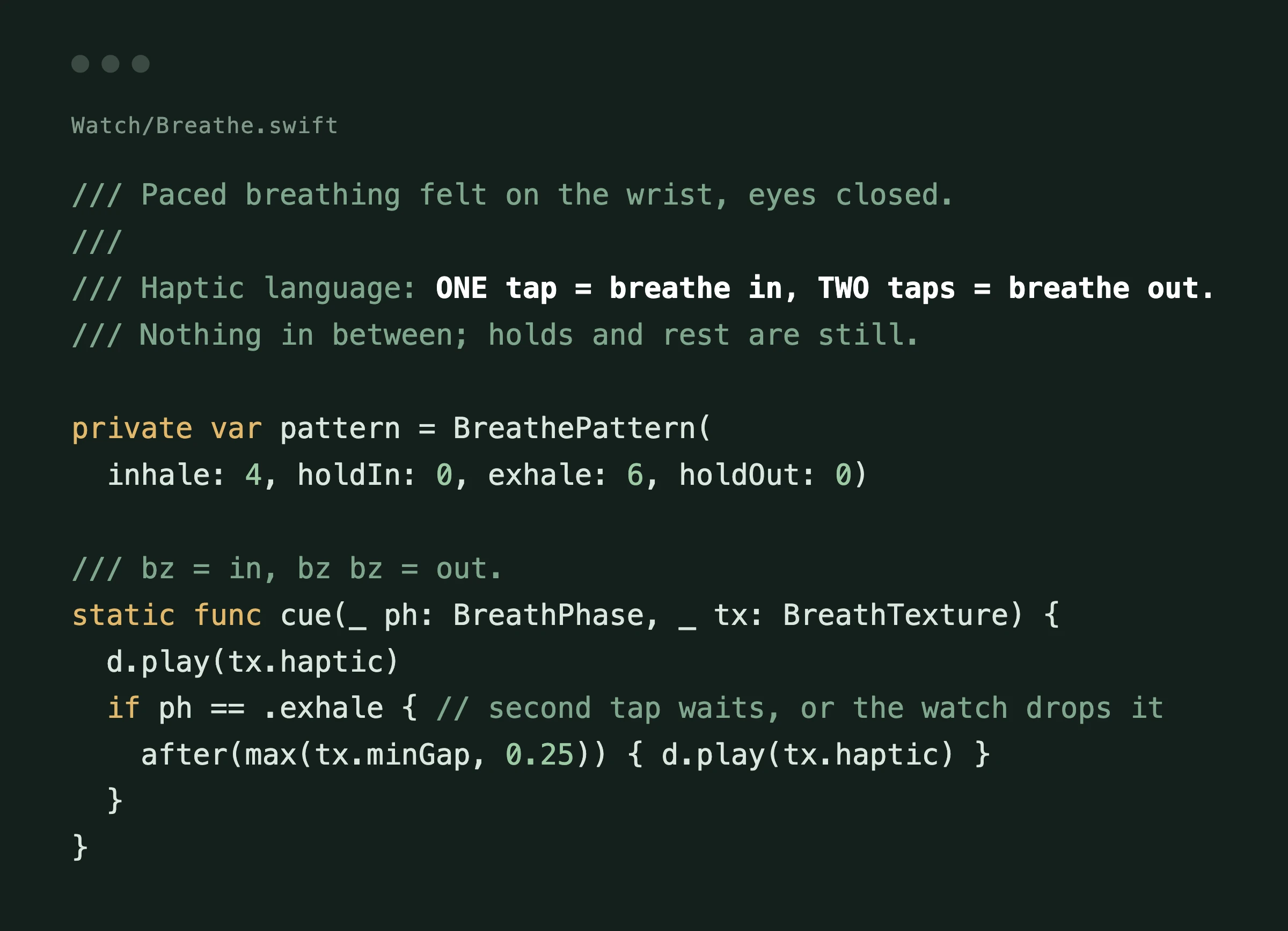 Health4-6 Breathing: I Taught My Apple Watch to Tap It Into My WristFour in, six out: six breaths a minute, the pace your heart rhythm likes. One afternoon, four versions, and a wrist that now says bz, bz bz.Read it 2026
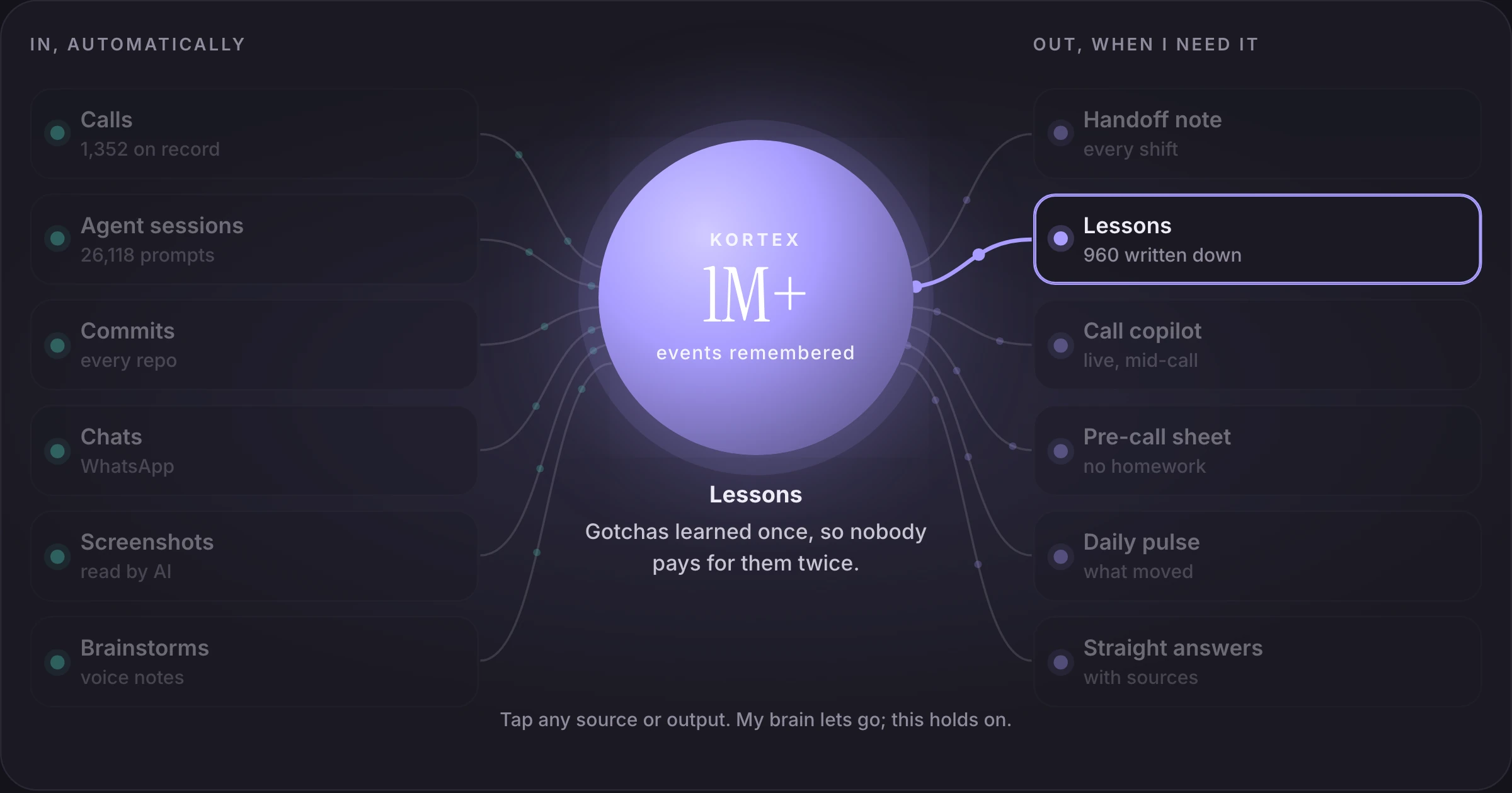 MemoryMy AI Second Brain: How MS and a Bad Memory Built KortexA brain that can't hold state built a system that holds it for him. Now the guy with the worst memory in the room walks in with the best one.Read it 2026WorkflowWorkflowBuild the demo before you pitch: skip the cover letterMy agent built a working parcel analysis for a startup, on their own SDK, in 14 minutes. Nobody asked. That's the point.Read it 2026